Coming soon
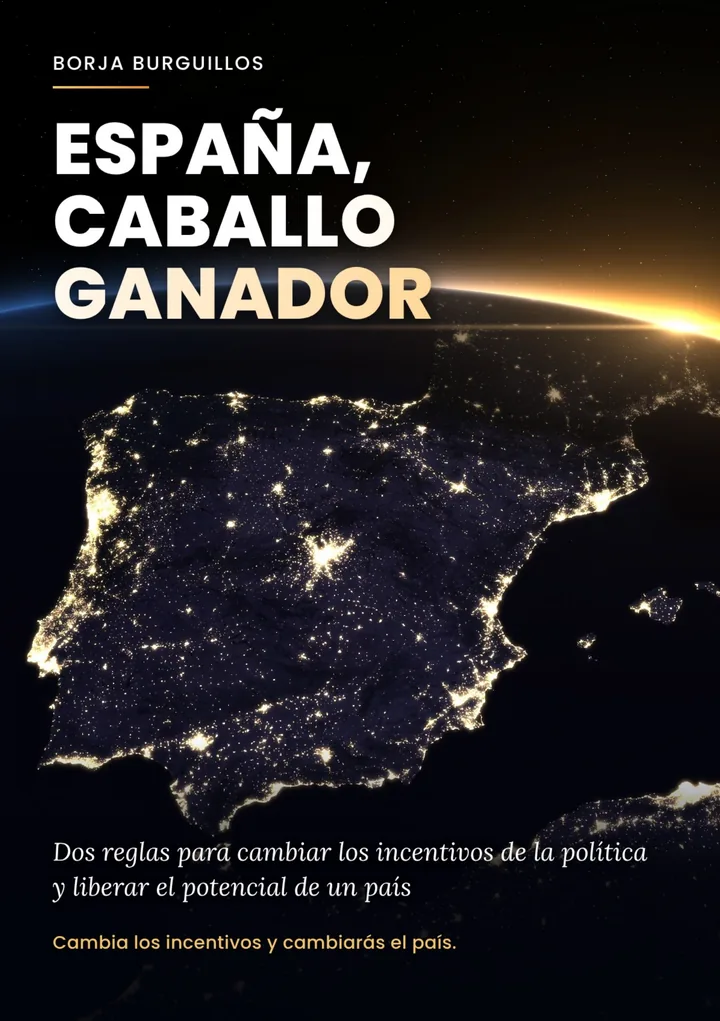
España, caballo ganador
Change the incentives and you change the country
In short
España, caballo ganador argues that politicians respond to rules like everyone else, and that changing two electoral rules would change what Spanish politics rewards. Spain is not short of reform ideas; nobody has an incentive to carry them out. The book proposes open lists on the Finnish model and a national threshold on the Czech model, and tests both against the evidence.
“No one chooses the country they are born in. All of us can choose the country we leave behind.”
What the book argues
In 2007, income per person in Spain stood at 104% of the EU average, measured in purchasing power. By 2025 it was 92%. Between 2007 and 2019, real income per person grew 3.6% in Spain against 10.9% in the EU: Spain kept moving, but at a third of its neighbours’ speed. The diagnoses and the reforms have been known for years. What is missing is a reason for anyone in politics to carry them out.
Borja spent his career on how organisations evaluate and pay people, and learned one thing: people do what the system rewards, not what they are asked to do. Applied to Spain, that points to two rules. With closed lists, an MP’s career depends on whoever writes the list, not on voters. And when a handful of seats decides who governs, paying the price of a kingmaker party is the rational choice, even if the whole country pays for it.
Key ideas
Measure 1: open lists (the Finnish model)
Voters choose a person, not a list. The seat then depends on voters, and parties have a reason to recruit talent who bring their own votes.
Measure 2: a national threshold (the Czech model)
To enter Congress, a candidacy would need 5% of the national vote (8% for two-party coalitions, 11% for three or more) and a presence in at least 13 of Spain’s 52 constituencies.
A territorial Senate
Regions that lose weight in Congress gain it where it matters for them: a Senate with a real veto over regional matters.
Necessary, not sufficient
The two rules will not cut unemployment or fix housing on their own. They turn reforms the system punishes today into something a politician can gain from defending.
The chapters, in one sentence each
- Why I wrote this book: politicians respond to rules like the rest of us. Change two electoral rules and you change what politics rewards.
- Incentives move the world: people do what the system rewards, not what they are asked. And rules also decide who gets in.
- The country that stalled: Spain has lost ground to Europe since 2007, not for lack of ideas but because no one gains from applying them.
- The current game (1), the list: with closed lists, an MP’s career depends on whoever writes the list, not on voters.
- The current game (2), the kingmaker: when a few seats decide who governs, paying the kingmaker’s price is rational, even if the country pays.
- Measure 1, open lists: if voters choose the person, the seat depends on voters and parties gain from recruiting talent.
- Measure 2, the national threshold: entering Congress requires national support, with a minimum vote share and a presence in 13 of 52 constituencies.
- The territorial Senate: what regions lose in Congress they gain in a Senate with a real veto over regional matters.
- Objections, and who loses: both measures carry risks, winners and losers, laid out without softening.
- The bold option, one MP per district: studied, not proposed. In Spain it would turn a third of the vote into an absolute majority.
- The winning horse: rules don’t play the game, but they decide which moves pay. Changing them is the condition for everything else.
Who it’s for
Citizens tired of the same debate
Anyone who wonders why Spain diagnoses its problems so well and fixes so few of them.
People who work in or around politics
Advisers, journalists, academics and party members who want a concrete, testable proposal.
Business and management readers
Anyone who knows from experience that incentives explain behaviour better than intentions.
Spaniards abroad
Readers who see Spain from outside and want it to compete with the best.
Questions
When does España, caballo ganador come out?
It is in progress. Leave your email on this page or follow @Borbur on X to hear first when it is published.
What are the two rules the book proposes?
Open lists, so voters choose individual candidates as in Finland, and a national threshold of 5% of the vote (8% and 11% for coalitions) plus a presence in at least 13 of 52 constituencies, inspired by the Czech Republic.
Does the book take a party side?
No. It focuses on the rules of the game, not on parties, and sets out the risks, winners and losers of its own proposals.
Will it be published in English?
It is being written in Spanish. Follow @Borbur on X for news about other editions.
More books


Guides

Borja Burguillos
Borja writes for people who want to understand money without the jargon. Born in Madrid and based in Dubai since 2012, he has advised companies on people and pay, built tech startups, and co-chairs the People & Organisation Committee at the Middle East Stablecoin Association.
WorldatWork Total Rewards and CAIA certified, CFA Investment Foundations, executive programmes at Wharton and IE Business School.